


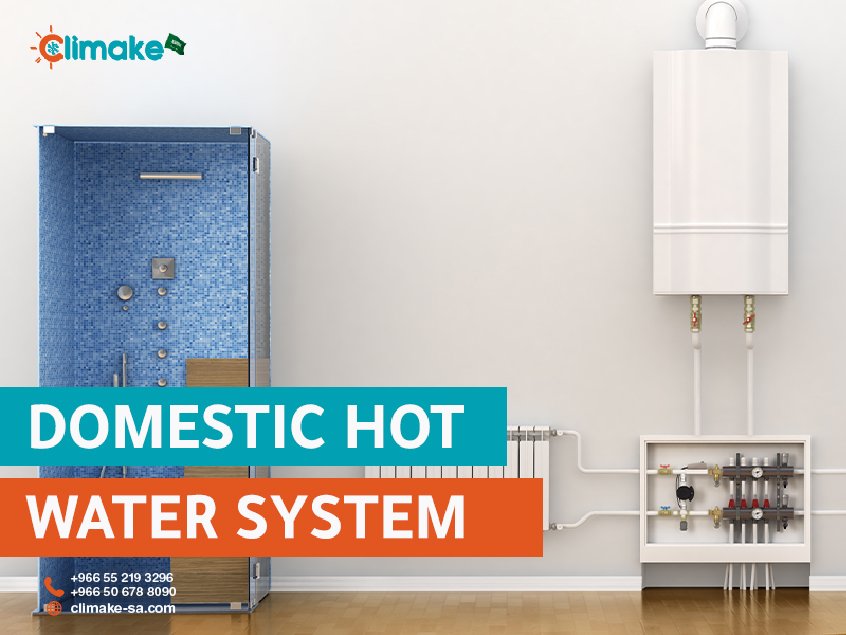
A reliable Domestic Hot Water Supply System system is essential for modern residential and commercial buildings in Saudi Arabia. Hot water is required for showers, bathrooms, kitchens, laundry areas, cleaning, and other building applications.
Choosing the right domestic hot water system involves more than selecting a water heater. The system must be designed around hot water demand, peak usage, heating technology, storage requirements, distribution piping, insulation, controls, and the specific requirements of the building.
This guide explains how domestic hot water systems work, the main technologies available, how to size them, and what to consider when planning a DHW system in Saudi Arabia.
What Is Domestic Hot Water Supply System (DHW)?
Domestic Hot Water (DHW) refers to heated potable water supplied to fixtures and equipment for everyday domestic or building-related uses.
A complete DHW system can include:
- A water heating source
- Heat transfer equipment
- Storage tanks when required
- Hot water distribution piping
- Recirculation equipment
- Temperature and pressure controls
- Safety devices
- End-use fixtures
The exact configuration depends on the building type, hot water demand, available energy sources, and operating requirements.
How Does a Domestic Hot Water Supply System Work?
A domestic hot water system begins with cold water entering the heating equipment. The selected heat source raises the water temperature, after which the hot water is either stored in a tank or supplied directly to the points of use.
In larger buildings, a circulation or recirculation system may be used to maintain hot water availability throughout the distribution network.
The main stages are:
- Cold water enters the system.
- The selected heat source transfers energy to the water.
- Hot water is stored or supplied directly.
- Distribution piping delivers hot water to fixtures.
- Controls regulate temperature and system operation.
- Recirculation may return cooled water to the heating system in larger networks.
Proper system design is important because poorly sized equipment, long piping runs, inadequate insulation, or unsuitable controls can increase water and energy losses.
What Are the Main Types of Domestic Hot Water Systems?
There is no single DHW configuration suitable for every building. Systems are generally selected according to building size, hot water demand, available space, operating pattern, and energy objectives.
Centralized Hot Water Systems
A centralized system produces hot water at a central plant or equipment room and distributes it throughout the building.
This configuration can be suitable for:
- Large villas
- Residential compounds
- Apartment buildings
- Hotels
- Commercial facilities
- Other buildings with multiple hot water demand points
Centralized systems can incorporate storage tanks, circulation pumps, heat exchangers, and recirculation loops depending on project requirements.
Decentralized and Point-of-Use Systems
Decentralized systems generate hot water close to the point of consumption.
They can be practical when:
- Hot water demand is limited
- The building has several independent zones
- Long distribution piping would create unnecessary losses
- A dedicated water heater is preferred for a specific area
The appropriate configuration depends on the number and location of fixtures and the expected demand pattern.
Storage Water Heating Systems
Storage systems heat and hold a volume of hot water in an insulated tank.
Storage can help meet periods of high demand because the system can supply water from the tank while the heating equipment continues recovering the stored volume.
What Are the Main Heat Sources for Domestic Hot Water?
The heat source is one of the most important decisions when designing a DHW system.
Electric Water Heating
Electric water heaters use electrical resistance elements to heat water. They are widely used in residential applications and can be configured as storage or instantaneous systems.
The suitability of electric heating depends on the required capacity, electrical infrastructure, operating pattern, and energy objectives.
For projects in Saudi Arabia, the selected equipment should also meet applicable Saudi requirements and product standards.
Heat Pump Water Heating
Heat pump water heaters use electricity to transfer heat from the surrounding environment into the water rather than generating heat directly through resistance heating.
This technology can provide substantially higher efficiency than conventional electric-resistance water heating under suitable operating conditions.
A heat pump water heating system should be evaluated based on the available installation space, ambient conditions, hot water demand, required temperature, equipment performance, and project operating profile.
How Do You Size a Domestic Hot Water System?
Correct sizing is one of the most important parts of DHW system design.
An oversized system can increase equipment and operating costs, while an undersized system may fail to provide enough hot water during periods of high demand.
Sizing should consider:
- Number of occupants or users
- Number and type of fixtures
- Number of bathrooms
- Expected simultaneous usage
- Daily hot water demand
- Peak demand periods
- Required hot water temperature
- Cold water inlet temperature
- Storage volume
- Recovery rate
- Distribution system characteristics
- Building operating schedule
For commercial projects, demand patterns can differ significantly between hotels, hospitals, offices, restaurants, and residential buildings. Therefore, professional demand calculations are preferable to using a simple area-based estimate.
Storage Capacity vs Recovery Rate
Storage capacity and recovery rate are two different factors.
Storage capacity refers to how much hot water the system can hold.
Recovery rate refers to how quickly the system can replace the hot water that has been consumed.
A project with high short-term demand may require a combination of adequate storage and sufficient recovery capacity rather than simply installing the largest possible tank.
This is particularly important in hotels, compounds, apartment buildings, and other facilities where multiple users may require hot water at the same time.
How Can You Improve Domestic Hot Water Energy Efficiency?
Several design decisions can improve DHW efficiency:
- Select an appropriately sized heating system.
- Avoid unnecessary oversizing.
- Use high-efficiency heating technology where suitable.
- Insulate hot water distribution piping.
- Minimize unnecessary pipe lengths.
- Use suitable storage tank insulation.
- Control recirculation pumps according to project requirements.
- Use appropriate temperature controls.
- Maintain heat exchangers and storage equipment.
- Address scale and water-quality problems.
- Evaluate the system using operating costs and life-cycle considerations rather than initial equipment cost alone.
Domestic Hot Water Design Considerations in Saudi Arabia
Saudi projects require consideration of local climate, building use, water quality, available energy sources, and applicable regulations.
Climate and Installation Environment
Ambient conditions can influence equipment performance and installation requirements, particularly for heat pump water heaters and outdoor equipment.
Equipment should therefore be selected according to the manufacturer’s operating range and the actual installation environment.
Water Quality and Scale
Water quality can affect the long-term performance of water heating equipment.
Hard water can contribute to scale formation on heat-transfer surfaces and inside equipment. Over time, scale can reduce heat-transfer performance and increase maintenance requirements.
Water quality should therefore be considered during the design and maintenance planning process, particularly for systems operating at higher temperatures or in areas with challenging water conditions.
Saudi Standards and Building Requirements
Domestic hot water installations in Saudi Arabia should be designed and installed according to applicable Saudi Building Code requirements, plumbing requirements, product standards, and manufacturer instructions.
For example, Saudi requirements address water heating equipment, hot water piping, insulation, and safety provisions. Applicable SASO requirements should also be checked for the selected equipment.
Which Domestic Hot Water System Is Suitable for Your Project?
The appropriate system depends on the building and its usage rather than on a single technology being suitable for every project.
| Project Type | Main Considerations |
| Villa | Occupancy, bathrooms, peak demand, available installation space |
| Apartment Building | Multiple users, peak demand, storage, distribution and recirculation |
| Hotel | High peak demand, reliability, storage, recovery and redundancy |
| Residential Compound | Central plant, distribution distance, storage and circulation |
| Office | Operating schedule, fixture demand and hot water usage |
| Small Apartment | Limited demand, available space and point-of-use options |
For larger projects, a centralized system may provide a practical architecture, while smaller applications may benefit from decentralized or point-of-use solutions.
Domestic Hot Water Installation
Professional installation should cover more than connecting a water heater to the plumbing network.
A typical project process includes:
- Assessing the building and hot water requirements.
- Calculating demand and peak usage.
- Selecting the heating technology.
- Determining storage and recovery requirements.
- Designing the hot water distribution network.
- Planning recirculation where required.
- Selecting suitable controls and safety devices.
- Installing and insulating the piping.
- Installing the heating and storage equipment.
- Testing and commissioning the complete system.
The installation timeline depends on the project size, equipment type, construction stage, piping complexity, and commissioning requirements. There is no universal installation period for every DHW project.
Domestic Hot Water Safety and Temperature Control
Safety should be considered during both system design and operation.
Domestic hot water systems may require temperature controls, pressure protection, and suitable mixing devices depending on the system configuration and applicable code requirements.
A thermostatic mixing valve can help control the temperature delivered to fixtures and reduce the risk of excessively hot water reaching users.
Hot water systems should also be designed and maintained with water hygiene in mind. Temperature management, system cleanliness, storage conditions, and maintenance procedures should follow applicable codes, project requirements, and manufacturer recommendations.
How Much Does a Domestic Hot Water System Cost in Saudi Arabia?
There is no single price for a domestic hot water system because the total project cost depends on several variables.
The main cost factors include:
- Heating technology
- Equipment capacity
- Storage tank size
- Number of fixtures
- Building size and usage
- Piping length
- Recirculation requirements
- Insulation
- Controls
- Installation complexity
- Existing infrastructure
- Testing and commissioning requirements
For a meaningful quotation, the project should first be assessed based on actual hot water demand and system requirements.
Why Choose a Professional Domestic Hot Water Installation?
A professionally designed DHW system is based on the building’s actual demand rather than simply selecting a water heater by size.
A qualified installation team can help with:
- System selection
- Demand and capacity assessment
- Equipment specification
- Hot water distribution design
- Storage and recirculation planning
- Installation
- Testing and commissioning
- Maintenance planning
For projects in Saudi Arabia, working with a provider familiar with local building requirements and environmental conditions can also simplify system selection and installation.
Frequently Asked Questions About Domestic Hot Water
Domestic Hot Water (DHW) means heated potable water supplied for domestic and building uses such as showers, bathrooms, kitchens, laundry, and cleaning.
What are the main types of domestic hot water systems?
The main configurations include centralized, decentralized, storage, and tankless systems. The heating source may include electricity, heat pumps, solar thermal systems, or boiler-based systems.
Is a centralized hot water system suitable for villas?
A centralized system can be suitable for villas with multiple bathrooms and significant hot water demand, particularly when hot water needs to be distributed across several areas.
Is a heat pump water heater suitable for Saudi Arabia?
A heat pump water heater can be suitable in Saudi Arabia when its operating conditions, installation environment, capacity, and project requirements are appropriate.
How is a domestic hot water system sized?
Sizing should consider hot water demand, peak usage, fixture types, required temperature, storage capacity, recovery rate, and the building's operating pattern.
Does hot water pipe insulation reduce energy loss?
Yes. Proper insulation reduces heat loss from hot water distribution piping and can improve overall distribution efficiency.
Does a domestic hot water system require recirculation?
Not always. Recirculation is mainly considered when the distribution network or building usage requires faster hot water availability and temperature maintenance.
How often should a domestic hot water system be maintained?
Maintenance frequency depends on the equipment, water quality, operating conditions, and manufacturer requirements. Regular inspection is recommended to identify scale, corrosion, control, and performance issues.
Can one domestic hot water system serve multiple buildings?
Yes. A centralized DHW plant can be designed to serve multiple buildings when the heating capacity, storage, distribution network, controls, and circulation system are properly designed.
Domestic Hot Water Solutions in Saudi Arabia
If you are planning a new building, residential villa, compound, hotel, or commercial facility, the right DHW solution should be selected according to actual demand, building requirements, energy source, and long-term operating needs.
Climake can assess your project requirements and help determine the appropriate domestic hot water system, equipment configuration, and installation approach for the Saudi market.
For project consultation:
WhatsApp: 966508656011
Phone: 966567863898