


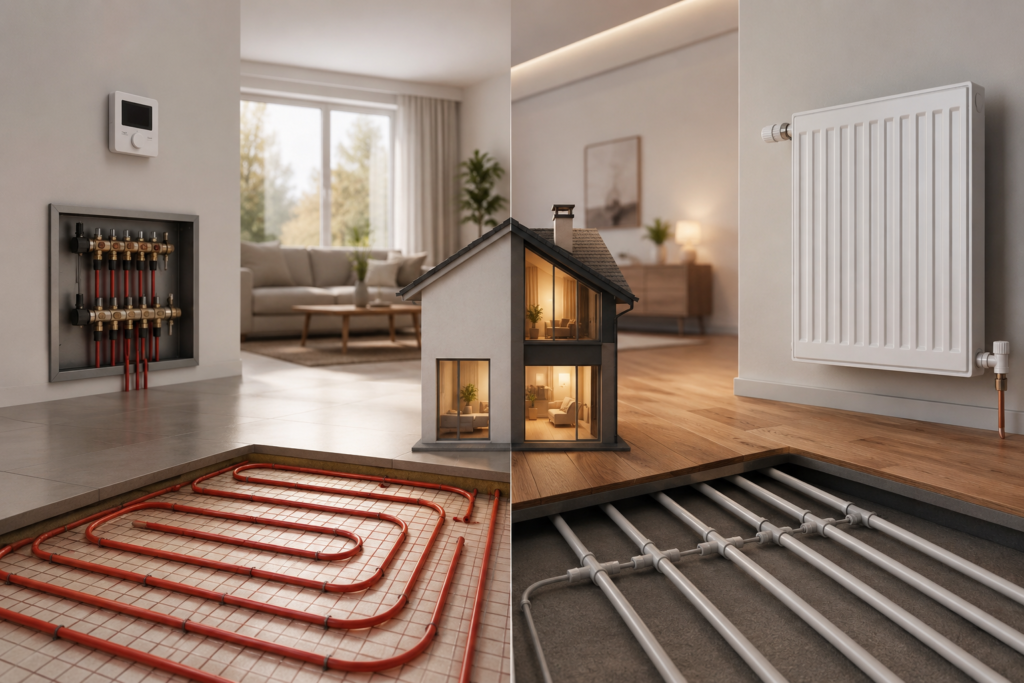
Choosing the right heating system is an important decision when building a new villa, finishing a property, or renovating an existing home in Saudi Arabia.
Two options that homeowners frequently compare are electric underfloor heating and central heating. Both can provide comfortable indoor heating, but they are not exactly the same type of solution.
So, which one is better?
The answer depends on your property, heating requirements, construction stage, insulation, electrical capacity, number of rooms, flooring, desired comfort, and long-term operating needs.
In this guide, we compare Electric Underfloor Heating vs Central Heating in practical terms, including installation, comfort, energy efficiency, running costs, flooring, zoning, renovations, and suitability for different Saudi homes.
The goal is not to declare one system the winner for every property, but to help you understand which solution makes more sense for your specific project.
Electric Underfloor Heating vs Central Heating: What’s the Difference?
The first step is understanding what you are actually comparing.
Electric underfloor heating is a method of delivering heat through electric heating cables or mats installed beneath the floor finish. When electricity passes through the heating elements, they generate heat that transfers through the floor surface into the room.
Central heating, on the other hand, is a broader approach to heating a property from a central heat source. Depending on the system design, heat can be distributed through radiators, hydronic underfloor heating, or other heating terminals.
This distinction is important because central heating is not limited to radiators.
A central system may use a boiler, heat pump, or another heat source, while the heat can then be delivered through radiators or water-based underfloor heating.
Therefore, electric underfloor heating vs central heating is not always a direct comparison between two identical technologies. One describes a specific heat-delivery method, while the other can describe a complete whole-home heating approach.
Heat Source vs Heat Distribution: What Are You Actually Comparing?
A useful way to understand heating systems is to separate two concepts: how heat is produced and how heat is delivered.
Heat Source
The heat source is responsible for producing the heat.
Examples include:
- Electric heating.
- Boilers.
- Heat pumps.
- Other centralized heat sources.
Heat Distribution
The distribution system determines how that heat reaches the room.
Examples include:
- Electric underfloor heating.
- Hydronic underfloor heating.
- Radiators.
- Other heating terminals.
This distinction makes it easier to understand why a central heating system can include underfloor heating.
For example, a hydronic underfloor heating system may use a central heat source and distribute heated water through pipes beneath the floor.
Electric underfloor heating is different because the heating element itself is electric and is installed beneath the floor.
How Does Electric Underfloor Heating Work?
Electric underfloor heating uses heating cables or heating mats installed beneath the finished floor.
When the thermostat activates the system, electrical energy is converted into heat. The heating elements warm the floor surface, which then transfers heat into the room.
Because the heating system is installed beneath the floor, there are no visible radiators occupying wall space.
Modern electric floor heating can also be divided into different heating zones. Smart thermostats can allow homeowners to schedule heating and control individual areas according to their daily routines.
Climake’s electric underfloor heating solutions include low-profile systems and smart control options. Its GREMAKE solution also provides Wi-Fi control, scheduling, remote access, and zoned heating capabilities.
Main Advantages of Electric Underfloor Heating
- Invisible heating beneath the floor.
- Warm and comfortable floor surfaces.
- Low-profile installation options.
- No radiators occupying wall space.
- Room-by-room temperature control.
- Smart thermostat and scheduling options.
- Suitable for selected rooms or multiple zones.
- Particularly useful for suitable renovation and finishing projects.
- Minimal routine maintenance when correctly installed.
However, electric underfloor heating should be designed according to the property’s heating demand and electrical capacity rather than selected only because it is easy to install.
How Does Central Heating Work?
Central heating uses a central heat source to provide heating to different areas of a property.
The exact configuration depends on the selected heat source and distribution method.
For example, a central heating system may use the following:
- Radiators.
- Hydronic underfloor heating.
- Other water-based heating terminals.
In hydronic underfloor heating, heated water circulates through pipes installed beneath the floor. The floor then transfers heat into the room.
This approach can be especially attractive for new construction projects where the heating system can be incorporated into the building design from an early stage.
For larger villas and whole-home applications, central heating can provide a comprehensive heating strategy across multiple rooms.
Electric Underfloor Heating vs Radiators
For many homeowners, the practical question is not simply underfloor heating vs. central heating but electric underfloor heating vs. radiators.
Radiators typically provide heat from specific locations around the room. Underfloor heating distributes heat across a much larger surface area beneath the floor.
This creates differences in both comfort and interior design.
Electric Underfloor Heating
With electric floor heating, the heating elements remain hidden beneath the floor.
This means homeowners do not need to reserve wall space for radiators, which can provide greater flexibility when arranging furniture and planning interior design.
Radiators
Radiators remain visible and require suitable wall locations.
They can provide effective room heating, but their position should be considered when planning furniture, windows, wardrobes, and interior layouts.
For homeowners who prioritize clean lines and invisible heating, underfloor heating can therefore be an attractive alternative to conventional radiators.
Electric Underfloor Heating vs Central Heating: Key Differences
| Factor | Electric Underfloor Heating | Central Heating |
|---|---|---|
| Heat source | Electricity at the heating element | Central heat source |
| Heat distribution | Beneath the floor | Radiators, hydronic floor heating, or other terminals |
| Visible equipment | Hidden | It depends on distribution method |
| Room zoning | Excellent with suitable controls | Available depending on system design |
| Floor height | Low-profile options available | It depends on the system. |
| Whole-home suitability | Possible when correctly designed | Commonly suited to whole-home applications |
| Renovation suitability | Can be attractive for suitable projects | Depends on infrastructure and installation requirements |
| Installation planning | Important before final flooring | Particularly important during building design |
| Maintenance | Generally low for heating elements | Depends on heat source and components |
| Operating cost | Depends on electricity use and property demand | Depends on heat source, system design, and usage |
| Interior impact | Minimal | Radiators require wall space |
| Best use | Selected rooms, zones, renovations, modern interiors | Whole-home and larger residential systems |
The comparison shows why there is no universal winner.
The best heating system for a home depends on the property and the homeowner’s priorities.
Which System Costs More to Install?
Installation cost should not be compared using a single price per square meter. The total cost depends on several factors, including the system design, property size, installation requirements, and project complexity. Understanding these factors is an important part of planning heating system installation.
The actual project cost can depend on:
- Property size.
- Number of heated rooms.
- Heating capacity.
- Heating zones.
- Floor preparation.
- Electrical infrastructure.
- Pipes and hydraulic components.
- Heat source.
- Thermostats and controls.
- Insulation.
- Installation complexity.
- Flooring requirements.
Electric underfloor heating can be relatively straightforward for suitable projects because the system uses heating cables or mats rather than a network of water pipes.
However, the total cost still depends on the area being heated and the project requirements.
Central heating may require additional infrastructure, especially when installing a complete hydronic system, heat source, distribution network, controls, and radiators or underfloor pipes.
For this reason, homeowners should compare the complete installed system, not only the price of the heating element.
Which System Costs Less to Run?
This is one of the most common questions when comparing underfloor heating cost vs. central heating.
There is no universal answer because operating cost depends on much more than the heating technology itself.
Important factors include:
- Building insulation.
- Outdoor temperature.
- Desired indoor temperature.
- Heated floor area.
- Hours of operation.
- Thermostat settings.
- Number of heated rooms.
- Heat source.
- System sizing.
- Zoning and scheduling.
A simple way to think about heating operating cost is:
Heating demand × operating hours × energy cost × system performance
This is not a utility-bill calculation, but it helps explain why two homes using the same heating system can have very different operating costs.
The Saudi Energy Efficiency Center also notes that energy-saving outcomes can vary according to building condition, energy use, technology, and environmental conditions.
Therefore, homeowners should avoid choosing a heating system based on a generic claim that one technology is always cheaper to operate.
Which System Is More Energy Efficient?
Electric resistance heating converts electrical energy directly into heat at the heating element.
Central heating, however, can use different heat sources.
For example, a central system using a heat pump can have very different energy performance from a central system using another heat source.
This means that comparing electric underfloor heating vs central heating based only on the word “efficiency” can produce misleading conclusions.
A better comparison considers the entire system:
- Heat source.
- Building insulation.
- Heat loss.
- System design.
- Operating temperature.
- Thermostat control.
- Heating schedule.
- Room zoning.
- Installation quality.
In Saudi homes, insulation and building performance are particularly important because reducing unnecessary heat transfer can reduce the heating demand that the system needs to meet.
How Does Insulation Affect the Comparison?
A heating system cannot compensate indefinitely for poor building performance.
If a home loses heat quickly through walls, windows, doors, ceilings, or other building elements, the heating system may need to operate more frequently to maintain the desired indoor temperature.
That is why heating system selection should be considered together with:
- Thermal insulation.
- Windows and glazing.
- External walls.
- Doors.
- Roof construction.
- Thermal bridges.
- Air leakage.
The Saudi Energy Efficiency Center provides guidance and services related to assessing residential energy use and identifying opportunities to reduce electricity consumption.
For homeowners uncertain about their property’s performance, an energy assessment can therefore provide useful information before selecting a major heating solution.
Which Is Better for a New Villa?
A new villa provides the greatest flexibility because the heating system can be considered before the final construction and flooring stages.
Electric Underfloor Heating for a New Villa
Electric underfloor heating may be attractive when the homeowner wants:
- Invisible heating.
- Warm floors.
- Individual room control.
- Smart thermostat functionality.
- Minimal visible equipment.
- Heating in selected areas.
- A low-profile solution.
It can be considered for bathrooms, bedrooms, living rooms, and other spaces where floor comfort is important.
Central Heating for a New Villa
Central heating may be more suitable when the objective is a comprehensive heating system covering many rooms.
It can be designed around radiators or hydronic underfloor heating and can use different central heat sources.
For a large villa, the decision should be based on a room-by-room heating assessment rather than the initial equipment price alone.
Which Is Better for an Existing Home?
Existing homes have different constraints.
The homeowner may need to avoid:
- Major floor demolition.
- Significant changes in floor height.
- Extensive hydraulic pipework.
- Large structural modifications.
- Removing recently installed flooring.
This is one reason low-profile electric underfloor heating can be attractive for suitable renovation projects.
Climake’s electric underfloor heating systems are designed with a thin profile, with the service information indicating approximately 3–4.5 mm depending on the solution.
However, suitability should always be evaluated before installation.
The installer should consider:
- Existing floor construction.
- Final floor finish.
- Available electrical capacity.
- Insulation.
- Room usage.
- Heating demand.
- Thermostat zones.
If the floors are already being removed as part of a major renovation, a hydronic or central heating solution may also become practical to evaluate.
Can Electric Underfloor Heating Heat the Whole House?
Yes, electric underfloor heating can be designed to serve multiple rooms or even a whole property when the system is correctly sized.
However, whole-house heating requires more than installing heating mats in every room.
The design should consider:
- Total heat load.
- Available electrical capacity.
- Room-by-room heating requirements.
- Insulation.
- Floor construction.
- Operating schedule.
- Number of zones.
- Thermostat control.
- Expected operating cost.
For a large Saudi villa, it is therefore sensible to compare whole-home electric underfloor heating with a central or hydronic system before making the final decision.
How Electrical Capacity Affects Electric Underfloor Heating
This is an important consideration that is sometimes overlooked.
Electric underfloor heating adds an electrical load to the property.
Before installing a whole-home system, the electrical design should be reviewed to determine whether the available capacity can support the required heating zones together with the home’s other electrical loads.
This becomes particularly important when:
- Several rooms are heated simultaneously.
- The property is large.
- Heating is required for long periods.
- The home already has high electrical demand.
A professional assessment can determine the required electrical load and help establish an appropriate zoning and control strategy.
What Flooring Works Best with Underfloor Heating?
Flooring can affect how efficiently heat moves from the heating system into the room.
Ceramic and porcelain tiles, as well as stone surfaces, are commonly well suited because of their thermal properties.
Other flooring materials, including engineered wood and certain vinyl products, may also be compatible when their specifications allow underfloor heating.
The important factor is not simply the name of the flooring material.
You should also consider:
- Thermal resistance.
- Flooring thickness.
- Underlay.
- Adhesive.
- Maximum permitted temperature.
- Manufacturer requirements.
Technical guidance for underfloor heating commonly emphasizes the importance of maintaining an effective heat-transfer path from the heating system through the floor finish.
Therefore, flooring should be selected together with the heating system rather than treated as a completely separate decision.
Electric Underfloor Heating vs Radiators: Comfort Comparison
Comfort is one of the biggest reasons homeowners consider underfloor heating.
Radiators heat the room from localized points, while underfloor heating spreads the heat over a much larger surface area.
With a properly designed underfloor heating system, the floor becomes a large heat-emitting surface.
This can provide a different comfort experience, especially in rooms where people walk barefoot, such as bathrooms and bedrooms.
Radiators can also provide excellent heating when correctly sized and controlled.
Therefore, the better choice depends on whether your priority is:
- Warm floors.
- Invisible heating.
- Even heat distribution.
- Familiar radiator-based heating.
- Interior design flexibility.
- Whole-home heating.
Which Heating System Is Best for Different Saudi Homes?
Saudi Arabia contains different climates, property sizes, and construction types, so the ideal heating system can vary from one project to another.
Apartments
Electric underfloor heating may be suitable when only selected rooms require heating and the homeowner wants to avoid visible radiators.
New Villas
Both electric underfloor heating and central heating should be evaluated during the design stage.
Large Villas
A whole-home central or hydronic system may be worth considering alongside electric underfloor heating, especially when multiple rooms require heating for long periods.
Bathrooms
Electric underfloor heating can be particularly attractive because it provides warm flooring without visible heating equipment.
Existing Homes
A low-profile electric system may be worth evaluating when minimizing floor changes is important.
Major Renovations
If the floors are already being removed, homeowners may have more flexibility to compare electric, hydronic, and central heating solutions.
A Practical Decision Guide: Which System Should You Choose?
Use the following as a starting point.
| Your Situation | Option Worth Considering |
|---|---|
| You want warm bathroom floors | Electric underfloor heating |
| You want invisible heating | Electric underfloor heating |
| You are renovating and need a low-profile solution | Electric underfloor heating |
| You need heating in selected rooms | Electric underfloor heating |
| You want smart room-by-room control | Electric underfloor heating with zoning |
| You are building a large villa | Compare central and electric systems |
| You need comprehensive whole-home heating | Evaluate central heating |
| You already have radiator infrastructure | Central heating may be practical |
| You are designing the heating system from the beginning | Compare all suitable options |
| You are unsure about operating costs | Request a property-specific assessment |
This is a guide, not a substitute for a heating design assessment.
What Should You Check Before Choosing a Heating System?
Before choosing between electric underfloor heating and central heating, ask these questions:
1. What is the size of the property?
A small apartment and a large villa may require very different heating strategies.
2. How well is the building insulated?
Better insulation can reduce the heating demand.
3. Which rooms need heating?
You may not need the same heating strategy throughout the entire property.
4. Is the property under construction or already finished?
The installation stage can significantly affect which solutions are practical.
5. What flooring will be installed?
Flooring affects heat transfer and system design.
6. What electrical capacity is available?
This is particularly important for whole-home electric heating.
7. Do you want smart zoning?
If different rooms have different usage patterns, zoning can improve control.
8. What is the expected operating schedule?
A home used continuously has different requirements from a property used only at certain times.
9. What is the long-term heating strategy?
The initial installation price should not be the only consideration.
What Climake Checks Before Recommending a Heating System
A professional heating recommendation should begin with the property, not the product.
Before selecting a solution, the project should be evaluated according to factors such as:
- Room dimensions.
- Property size.
- Windows and external walls.
- Thermal insulation.
- Floor construction.
- Flooring material.
- Desired indoor temperature.
- Room usage.
- Heating demand.
- Electrical capacity.
- Number of heating zones.
- Construction stage.
- Control requirements.
This approach helps determine whether electric underfloor heating, central heating, radiators, hydronic underfloor heating, or a combination is the most appropriate solution.
For homeowners in Saudi Arabia, this project-specific approach is more reliable than choosing a system based only on online price comparisons or generic claims about efficiency.
Why Choose Climake for Heating Systems in Saudi Arabia?
Climake provides heating-related solutions for residential projects in Saudi Arabia, including electric underfloor heating, central heating, central hot water systems, and swimming pool heating solutions.
For electric underfloor heating, Climake provides low-profile solutions and smart control options designed around the requirements of modern residential projects.
The company’s GREMAKE solution includes smart Wi-Fi control, scheduling, remote access, and zoning capabilities.
The most important step, however, is choosing the right configuration for the property.
If you are building a new home, finishing a villa, or renovating an existing property, Climake can assess your requirements and help you compare the available heating options before installation.
Contact Climake to discuss the most suitable heating solution for your property in Saudi Arabia.
Phone: 966567863898
WhatsApp: 966508656011
Frequently Asked Questions
Is electric underfloor heating better than central heating?
Neither system is universally better. Electric underfloor heating can be attractive for selected rooms, renovations, invisible heating, warm floors, and smart zoning. Central heating can be more suitable for comprehensive whole-home heating, particularly in larger properties.
Is electric underfloor heating cheaper to run than central heating?
Not necessarily. Running costs depend on the property's heat demand, insulation, operating hours, electricity cost, system design, zoning, and the heat source used by the central system.
Is electric underfloor heating suitable for a Saudi villa?
Yes, it can be suitable when properly designed and sized. The property's size, insulation, electrical capacity, room usage, flooring, and heating demand should be assessed before installation.
Can electric underfloor heating heat an entire house?
Yes, it can be designed for multiple rooms or a whole house. However, the electrical load, heat demand, insulation, zoning, and expected operating cost should be evaluated first.
Is underfloor heating better than radiators?
Underfloor heating provides hidden heat across the floor surface and can offer warm floors and strong interior design flexibility. Radiators can also provide effective heating and may be practical for whole-room or existing central systems. The best choice depends on the property and heating requirements.
Does electric underfloor heating work under tiles?
Yes. Tiles and ceramic surfaces can be suitable for underfloor heating, provided the complete flooring system and installation materials meet the requirements of the heating system and flooring manufacturer.
Can underfloor heating be installed in an existing home?
Yes, depending on the floor construction and renovation requirements. Low-profile electric systems can be suitable for some renovation projects, but the floor level, electrical capacity, insulation, and final flooring should be evaluated first.
Does electric underfloor heating require a lot of maintenance?
The heating cables and mats generally require little routine maintenance when correctly installed. However, proper installation, testing, electrical protection, and thermostat configuration are essential.
What is the best heating system for a new villa in Saudi Arabia?
There is no single best system for every villa. The right choice depends on property size, insulation, heating demand, construction stage, electrical capacity, flooring, zoning requirements, and the desired heating strategy.
Should I choose electric underfloor heating or central heating during construction?
The decision should ideally be made before the final flooring and finishing stages. Early planning allows the heating system, electrical or hydraulic infrastructure, insulation, floor construction, and controls to be coordinated correctly.
Can underfloor heating work with wood or vinyl flooring?
It can, provided the specific flooring product is approved for underfloor heating and its thermal resistance and maximum operating temperature are compatible with the heating system.
Final Verdict: Electric Underfloor Heating vs Central Heating
When comparing Electric Underfloor Heating vs Central Heating, there is no universal winner.
Electric underfloor heating may be the better choice when you want:
- Invisible heating.
- Warm floors.
- Room-by-room control.
- Smart thermostat functionality.
- A low-profile solution.
- Heating in selected rooms.
- Greater interior design flexibility.
Central heating may be the better choice when you need:
- Comprehensive whole-home heating.
- Heating across many rooms.
- A centralized heat source.
- Radiators or hydronic underfloor heating.
- A system planned as part of a larger villa project.
For homeowners in Saudi Arabia, the smartest decision is to compare the complete system rather than focusing only on the initial installation price.
Consider the property’s insulation, heat demand, electrical capacity, flooring, construction stage, room usage, zoning requirements, and expected operating pattern.
If you are currently building, finishing, or renovating your home, Climake can help you evaluate your options and design a heating solution around the actual requirements of your property.
Call Climake at 966567863898 or contact us via WhatsApp at 966508656011 to discuss your project.